Netting community: Spee-Bi-Dah
Netting community: Spee-Bi-Dah
Part celebration, part classroom, all community: Tulalip’s Spee-Bi-Dah unites generations and guests to pull the seine, tend the clambake, and keep tradition alive. In one day, the shoreline becomes memory and medicine—proof that culture endures when many hands hold the net.
by Micheal Rios
Photos by Micheal Rios

On a cool summer morning, Spee-Bi-Dah beach was quiet and gray. A soft mist clung to the tide line, gulls floated on the breeze, and the air smelled faintly of salt and seaweed. By midday, as the sun broke free of the clouds, the beach transformed. Families poured in carrying chairs, blankets, and coolers. Children darted barefoot across the sand, their laughter rising above the waves. Smoke from a fire pit curled skyward, carrying with it the savory aroma of salmon roasting over open flame.
The Tulalip Tribe’s annual Spee-Bi-Dah beach seine had begun.
For the Tulalip people, whose homelands hug the Salish Sea, this event is more than a summer gathering. It’s a rare revival of a practice that once defined their way of life: seining the beaches for salmon.
The article continues below.

From Everyday Life to Once a Year
Only a few generations ago, beach seining was common across Coast Salish territories. Families camped on the shoreline year-round, setting nets in rhythm with the tides, providing sustenance and stability for their communities. Fishing was the everyday heartbeat of coastal life.
Tulalip elder Dean Ledford, now in his late 80s, remembers those days vividly. “We used to camp right out here in the 1950s,” he recalled, gesturing toward the beach. “No houses then, just the ocean and the camps. My uncle was the big fisherman of the family. He’d bring the teenagers out here with him and teach them to fish year-round. I’ll tell you what, there’s nothing like pulling in a frozen net in the winter. Was it difficult? Sure it was, but we did it together.”
Today, that life exists only in memory and in moments like Spee-Bi-Dah. Modern regulations, increasing urban development, and the pressures on smaller and smaller salmon runs have all but ended regular beach seining. What was once daily practice has become an annual celebration.
Today, Spee-Bi-Dah is a single day when the Tulalip people return to ancestral sands to honor the water that has always sustained them.
Pulling the Net, Pulling the Past
When the seine begins, dozens of people gather at the ropes. Teenagers laugh as they lean back with all their weight, while seasoned fishermen call out steady instructions. Elders, grounded in memory, watch carefully, offering advice when needed.
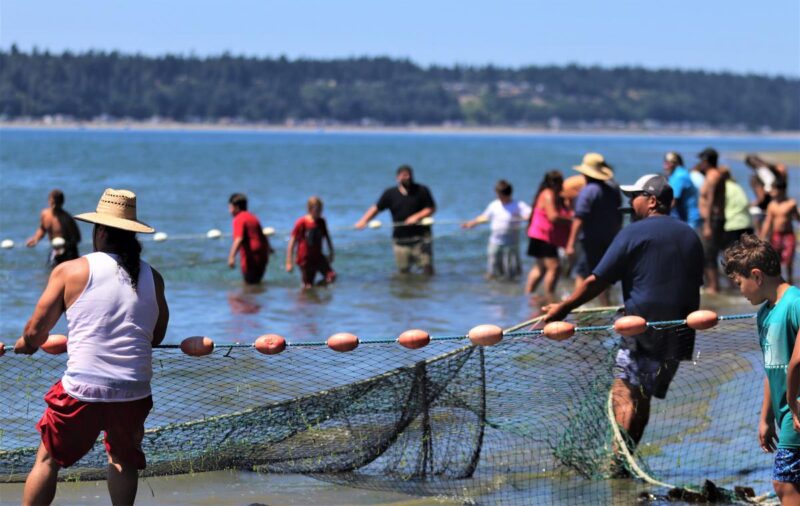
The work is physical, slow, and collective. As the net tightens, the water shimmers with life. Silver flashes break the surface as salmon leap in panic, attempting to escape the net, allowing the sunlight to scatter off their scales. Gasps ripple through the crowd, followed by cheers as the catch comes into view.
For many of the youth, this is their first time hauling a net, their first tactile connection to a practice their great-grandparents once considered ordinary.
“You can’t just go seining anymore,” said fisherwoman Darkfeather Anchetta, her hands gripping the wet rope, water lapping at her waist. “So to see the youth who run up to grab part of the net and then pull with every bit of strength they have, it’s special. They are learning by doing what it means to live by the sea.”
A Feast in the Old Way
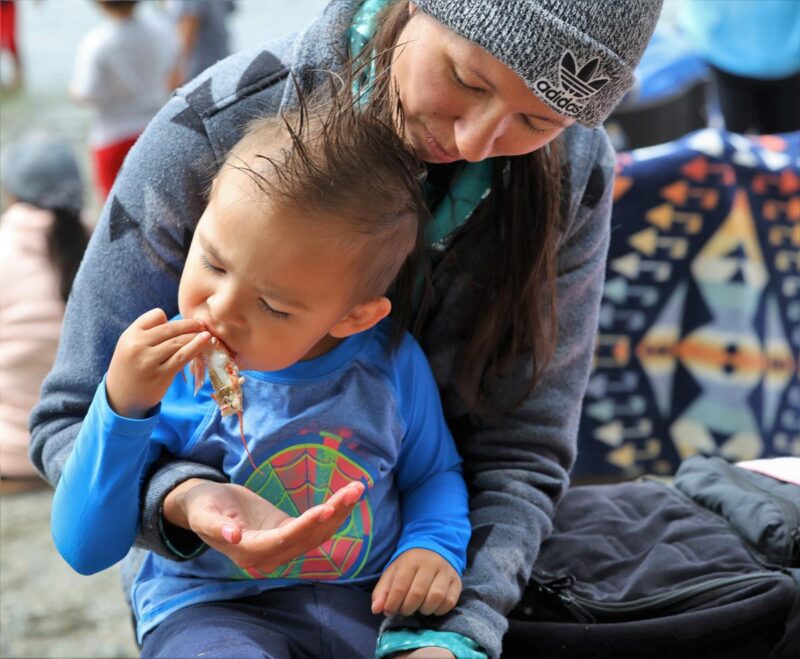
While the seine unfolds at the shoreline, another traditional rhythm beats nearby. A clambake pit, heated by fire and stones, releases plumes of steam as layers of seafood are unearthed: clams, shrimp, crab, each infused with the earthiness of seaweed and wood-fired smoke.
Plates fill quickly with steamed shellfish and salmon smoked to perfection. Families cluster on blankets and driftwood benches, balancing food in their laps while stories spill out as freely as the tide.
Pitmaster Tony Hatch has overseen the clambake for years. “We’ve become a well-oiled machine,” he said, laughing with rake in hand. “My crew consists of my three kids, several nieces and nephews, and a few others who show up every year and put in the work. Eventually, I want to step back and sit in my chair while one of my kids take the lead. That’s how we empower the next generation to step up and really embrace their culture. First, we teach them. Then, we let them lead.”
Food here isn’t a simple meal. It is memory made edible, a connection to the same abundance that sustained generations.
Storytelling by the Sea
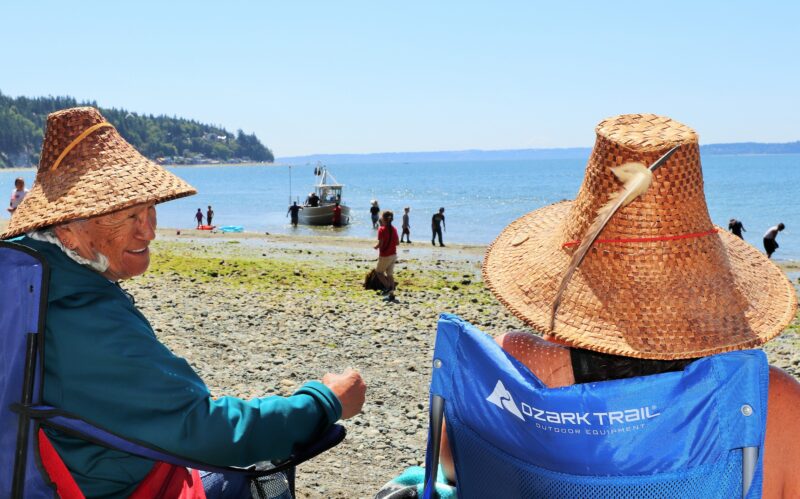
As the afternoon lingers, stories surface as naturally as the tide. A grandmother points to the water, recalling the dugout canoes of her childhood. Her great-grandchildren splash in the same waves, carrying forward the continuity of place.
Quileute elder Harvey Eastman, walking with his grandson, said simply, “The seafood bounty is something that is passed down from generation to generation, just to share with family and friends. It’s so good to see all the smiling faces. The sun is shining. I couldn’t ask for more.”
Nearby, his daughter Marysa held her infant son. “This is Jonah’s first Spee-Bi-Dah,” she said with a smile. “My grandma Joy was telling us about her memories of splashing on a row boat out here when she was a little kid. Now, my kids, her great-grandbabies are here splashing in the same water.”
Welcoming Hands
Though rooted in Tulalip heritage, Spee-Bi-Dah extends beyond tribal lines. Friends, relatives, and visitors are folded into the circle. Not as observers but as participants.

One such participant, Henry Dwan, a Taiwanese-born resident of nearby Shoreline, was spotted hauling the seine alongside Tulalip youth. Later he carried trays of steaming seafood to the tables. “Back home, I grew up on an island surrounded by water,” he said.
“Being here and being surrounded by the water and being immersed in the nature is such a gift. I feel such a blessing being here and seeing everyone enjoy Mother Nature’s gifts.”
The Salish Sea Connection
For the Tulalip Tribe, Spee-Bi-Dah is filled with nostalgia of a bygone time. It’s also a living affirmation of their enduring relationship with the Salish Sea. The water is a caring relative, a generous provider, and vigilant teacher. Through fishing, cooking, storytelling, and gathering, that connection continues, even as circumstances change.
What was once the everyday rhythm of life is now concentrated into a single day. Yet in that one glorious day, the Tulalip community, and those invited into it, experience a glimpse of what it means to live in reciprocity with the sea.
“Days like this are how we keep our traditions strong and our people connected,” Darkfeather reflected after hauling in a massive set of twenty-three salmon.
“You see kids learning from elders, cousins playing together, aunties laughing, and our people taking in that good medicine from eating traditional foods. It’s our people connecting with the water and each other. That’s what Spee-Bi-Dah is all about.”
More Than Memory
As evening sets in, the shoreline begins to quiet. Nets are rolled, fire pits cool, families pack up blankets and chairs. The laughter fades into the sound of waves brushing the sand.
What remains is not silence, but renewal.
Spee-Bi-Dah may only come once a year now, but in that day, it carries the weight of centuries. It is proof that even when practices shift, the essence remains. Through the pull of a net, the taste of smoked salmon, the laughter of children in the tide, Tulalip’s traditions endure.
On this small stretch of shoreline, the Salish Sea still gives. It gives fish, yes, but also unity, identity, and an opportunity to remember what it means to be a Tribe.