
125 Years of Showing Up
125 Years of Showing Up
As The Daily Herald marks 125 years, this reflection examines how shrinking newsrooms and rising isolation can weaken a community’s shared understanding. Through voices from Washington publishers and reporters, it makes the case for verified local reporting, its role in public accountability and connection, and the reader, advertiser and community support needed to sustain it.
Loneliness is climbing as local reporting thins — two symptoms of one condition. The Daily Herald is still connecting a county to itself.
BY ELLEN HIATT FOR WASHINGTON NEWSPAPER PUBLISHERS ASSOCIATION
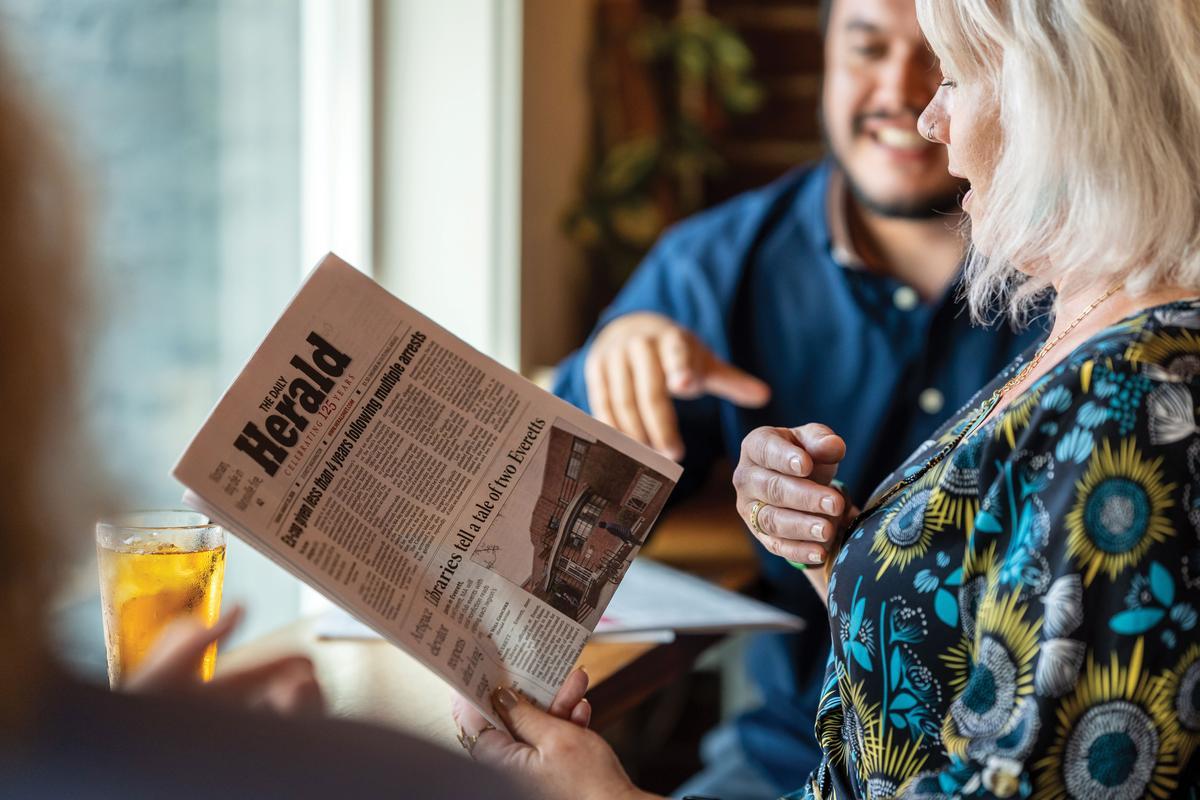
Of all the work I’ve done, nothing has given me a deeper connection or greater understanding of my community than my years as a journalist. Charged with understanding the people and events, and telling their story, it was an honor and a responsibility. Today, dramatically fewer reporters are doing this work, but the responsibility hasn’t shrunk in tandem. Interestingly, there is a parallel between the loss of local news outlets with the public’s rise in loneliness and self-isolation. It’s a correlation worth exploring, as we ask what kind of society we want to create for ourselves and future generations.
When Everett’s paper, The Daily Herald, turned 125, publisher Carrie Radcliff said the celebration was packed with advertisers, subscribers and donors — more than she expected, and among them former employees who still speak of it as their paper. She made sure the newsroom staff wore name tags: “They want to talk to you. They’re here to talk to you,” she said. People arrived looking for a byline: where’s Eliza? Oh, there’s Eliza.
Before the turn of the last century, nearly half a dozen newspapers could be found in every valley of this county — Everett alone once had four competing papers. The Daily Herald’s newsroom in Everett is down to 11 fulltime staffers. Radcliff says it is stable now, with no layoffs planned, but even fully staffed there are stories they don’t have the bandwidth to tell. The Herald is not unusual. Papers across the state, indeed the nation, are operating with the bare minimum. In King County, the Courier-Herald’s sole reporter in Enumclaw has watched the same thing happen over that paper’s own long history.
“When I started here 11 years ago, we had a newsroom of 12 to 13 people — four writers, ad designers, salespeople, office managers. Little by little, here I am, last man standing,” Editor Ray Miller-Still said.
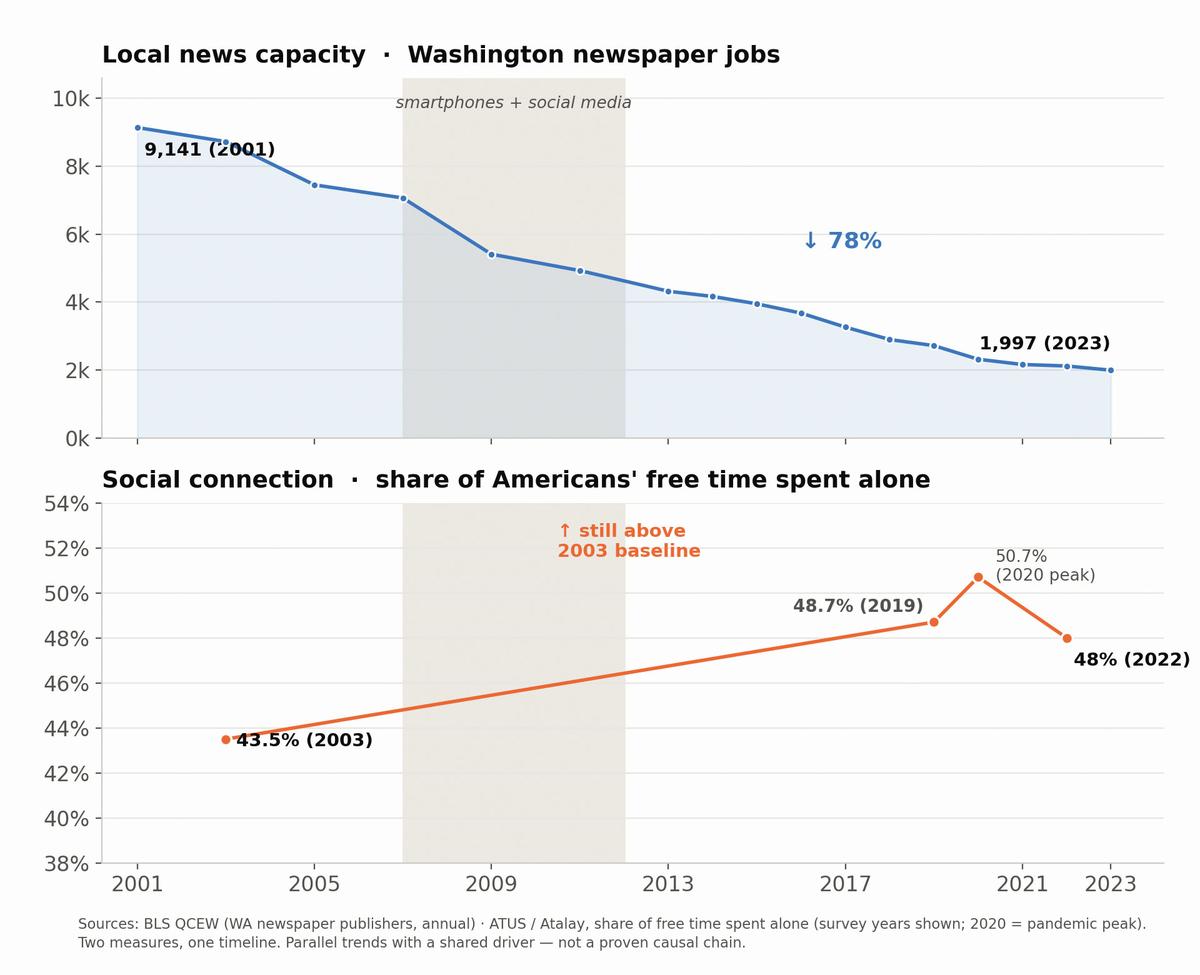
The internet and its many facets, from social media to digital advertising, have steadily picked off revenue streams that once made newspapers a profitable business. Say nothing of today’s unscrupulous scraping of copyrighted content and regurgitation and hallucination of the same in AI models. Since 2001, 43% of Washington’s newspaper operations have closed or consolidated, and newspaper jobs have fallen 78%.
The decline in local news outlets is simultaneous to increasing alienation. Half of American adults now report measurable loneliness, and the U.S. Surgeon General has likened its toll on our health to smoking fifteen cigarettes a day. Neither decline causes the other. Human connection is the victim of a bevy of cyber connection — that’s the throughline of loss shared by people and our news outlets. We’re isolating ourselves from each other and from the shared information that binds our human experience to each other’s.
The loss has a shared driver. Newspapers and neighbors alike are struggling to connect meaningfully against the powerful distraction of manufactured “news” and human connection made at arm’s length of a digital device.
The article continues below.

That fracture is already a working condition. Julia Tellman, a reporter at Cascadia Daily News, sees it in the people she covers. “So many of us are living in realities that do not line up with each other… so it is hard for us to find basic common understandings. That’s one of the biggest challenges we as local journalists face.”
And it’s why local news, and local news read by locals, matters more today than ever before.
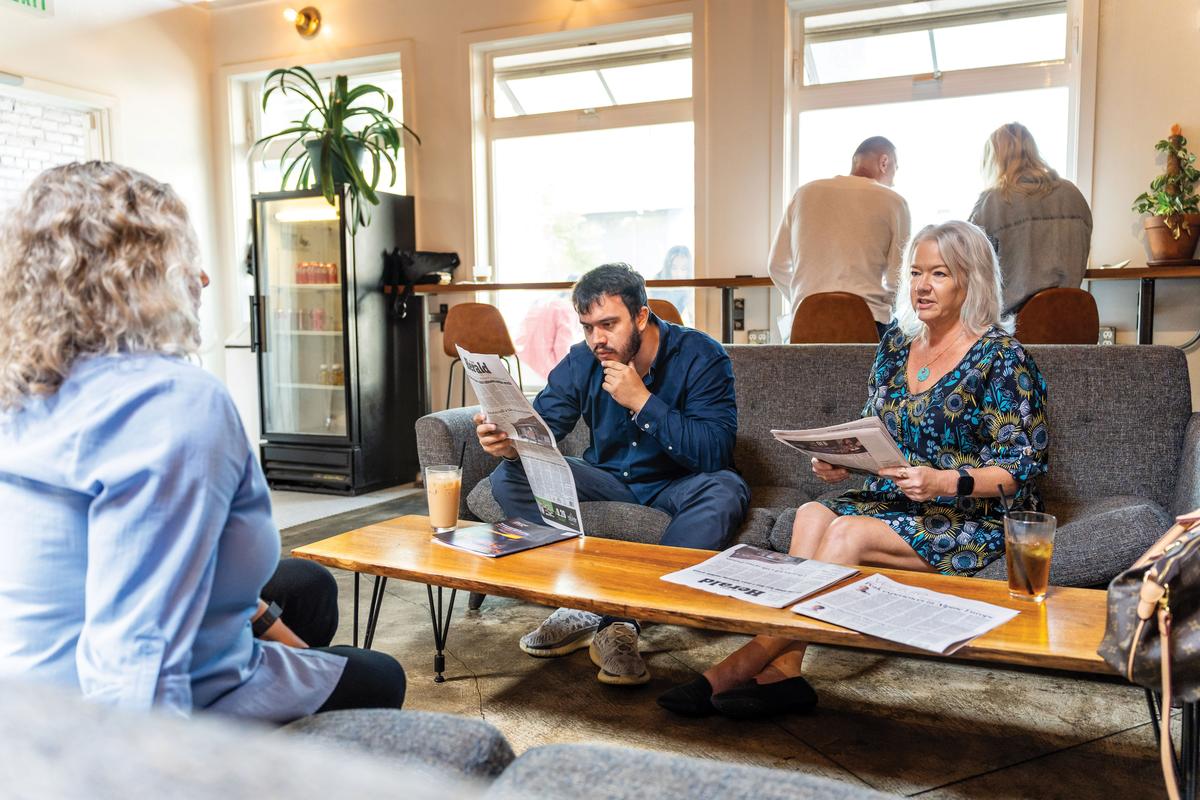
It’s no accident that local news — information produced by trained journalists who research, verify and vet the facts — doesn’t resemble a social media page’s conjecture and banter. Radcliff has watched a social media page break a story her newsroom was still holding. “We’re just waiting on this one piece,” her editor tells her. “We’re not going until it’s confirmed.” Of course her team would like to be first, but not at the cost of being wrong. That decision — made on deadline, by people whose names are on the work — is the difference between a newsroom and a feed.
The loss is not abstract. When the reporter disappears, the school board meets with no one taking notes, the county council votes with no one asking why, and the levy on your ballot arrives unexplained. Researchers have found that when a local paper closes, government waste and municipal borrowing costs rise, and illegal activity increases even in private industry.
In Winthrop, where 90% of fourth and fifth graders will shoot up their hands to report that they’ve seen themselves or a family member in the newspaper, local news builds community.
“A newspaper should connect people, it should communicate with people, it should get them civilly involved, and it should celebrate the community,” publisher Don Nelson said.
Jennifer Henrichsen, Assistant Professor and Research Director with the Washington News Ecosystem Project, has documented that progression and the efforts to shift it, including the WSU Murrow–Report for America partnership to place a reporter in every county by 2029.
At the Washington Newspaper Publishers Association (WNPA), we mark our 139th year this fall in Everett — two blocks from the Herald’s newsroom — with an annual convention and the Better Newspaper Contest, recognizing the good work of newspaper people across the state. We are steadfast that we can create a future where local news is valued, supported by readers, and part of building stronger, healthier communities.
Radcliff saw a version of that future with her 29-year-old daughter, who collects vinyl. Michelle Nedved of The Newport Miner passes along a phrase for the hope in that: “Print is the new vinyl.” Radcliff won’t oversell it — her own children grew up with the paper in the house and it isn’t where they go for news. “I work on that every day,” she said. And while some studies indicate Gen Z is looking for more in-person connection with others, and growing distrust of what they read online, it’s not enough to stave off the successive closure of papers on the horizon.
A growing number of innovations in funding and delivery are reaching new audiences and finding new revenue.
If accurate local news is important to you, ask yourself how you are supporting it. If you’re a teacher, are you sharing the news with your students, connecting them to their neighbors through a shared experience? If you’re a business person, consider what your advertising says about the paper as much as what it says about you. Print and HeraldNet ads are what the community sees, Radcliff points out; the email campaigns and programmatic display that carry much of the revenue are invisible. A thin paper reads as a dying paper. “We don’t look like we’re as viable as we really are,” she said. Your ad is a vote of confidence the whole county can see. And wherever you live, are you subscribing or donating to the paper that covers your town so it can keep a reporter at your city council and school board?
Together we will build the community we want. I don’t believe the trend line toward increased loneliness and decreased access to information will continue in perpetuity — because being on the verge of losing something so central to our health and happiness makes us work harder to restore it. Φ