

The Warp and Weft
The Warp and Weft
Kathy Coffey Solberg’s journey from tears before a loom to a workplace-transformation framework frames a meditation on how communities see, sustain and remake themselves. Through leadership programs, informal connectors, local reporting and gathering places, the piece considers why honest attention—and sometimes the difficult work of unweaving—must come before stronger patterns can take hold.
Before you rebuild, unweave
By Ellen Hiatt
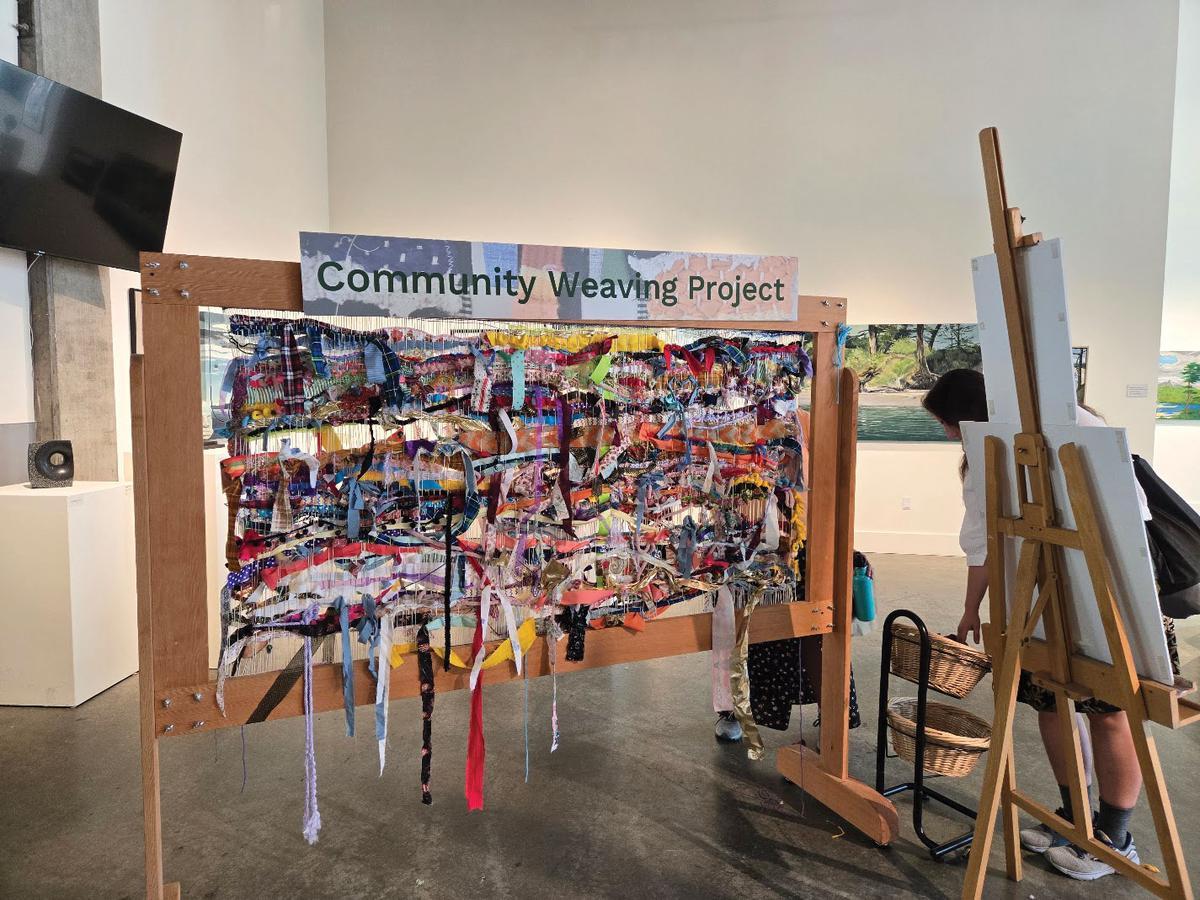
When Kathy Coffey Solberg first saw the loom named Penelope in the corner of an Oregon shop, she had to stop and touch it. She didn’t yet know it had a name, and she didn’t know why touching it brought her to tears. “I started crying,” she writes in her new book, Reweaving What Matters: Practical Tools for Workplace Transformation. “Not gentle tears – a rather surprising and consuming sort of crying in the middle of a weaving shop.”
The loom came home with her. She learned tapestry weaving, and she read the story of Penelope, Odysseus’ wife, who kept her suitors waiting for three years by weaving a shroud by day and unweaving it by night, taking her destiny into her own hands, weaving the life of her choosing.
Months later Solberg was working on another loom when she made a mistake that ran through a dozen rows of careful work. She had two choices: accept the flaw or undo it. She started pulling threads, and as her fingers worked backward through the pattern, she thought of Penelope. And she thought of the book she had been drafting for two years, called simply Reweaving. “That’s when it clicked,” she writes. “Unweaving was the path to Reweaving.”
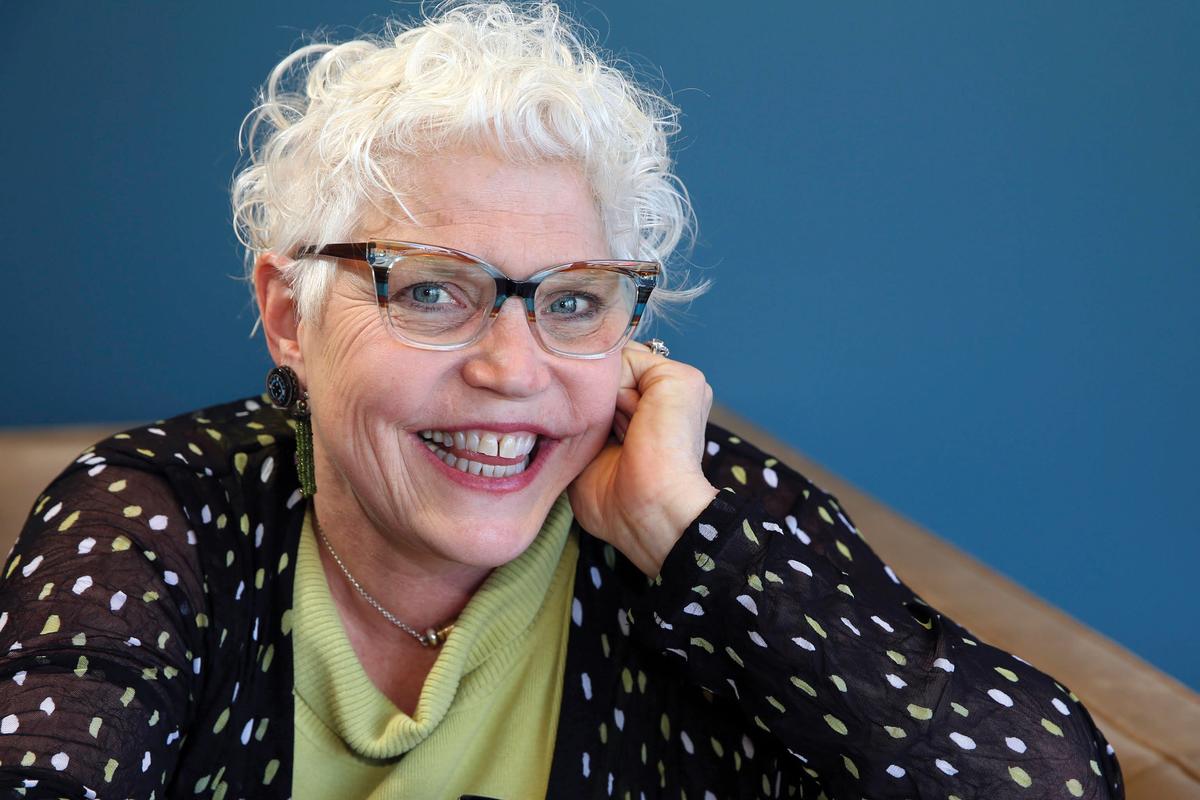
The revelation, in her words: “I’d been starting in the wrong place. You can’t reweave on a broken foundation. You can’t create new patterns without first examining — and often undoing — what’s already there.”
“That loom knew before I did.”
Solberg calls herself a community weaver — she has been one for 25 years, working with leaders in business, government and nonprofits — who only lately became a fiber weaver. Before she works with any group, whether a city council, a board or a planning team, she calls every member for 20 minutes first. She has turned down contracts from clients who won’t allow it.
She came to community, she writes, “through the absence of it.” Adopted at birth, she lost both her parents by the time she was 18 and had no living relatives on either side. She’s spent 16 years in higher education, including Bastyr University’s school of nutrition; nine years leading Leadership Snohomish County; and, since then, her own firm, CommonUnity Consulting.
Her framework begins with a step she calls Notice: seeing the fabric as it actually is, not as the org chart says it is.
I, too, spent time in a community leadership development program, as the one-time manager of Leadership Skagit. The perspective the program provides is a stunning window into community – the kind that Solberg has devoted her life to building.
The article continues below.

Any given fall, the Leadership Skagit group convenes its newest cohort to learn the impact of the power company, the farmer, the tribe, the state, and the county on water quality and salmon runs. By spring they’ve talked with public agencies and nonprofits about collaborations to reduce incarceration and lift people out of troubled lives. In the year I managed the program, led by the local college, I witnessed participants’ personal transformations and the lightbulb moments of a deepened understanding of their community.
Most people don’t sign up for a community leadership program to explore the warp and weft of a community’s fabric. Most of us learn these things secondhand, if we learn them at all — from a neighbor, a public meeting, or the local newspaper reporter who bothered to sit through it.
A leadership program is one way a community learns to notice itself. But the load-bearing threads, Solberg writes, are rarely the ones with titles.
“The person with the title may have less influence than the grandmother who knows everyone’s story, the shop owner who translates documents, or the coach who mentors youth. These informal weavers hold communities together in ways that formal leadership rarely recognizes,” she writes.
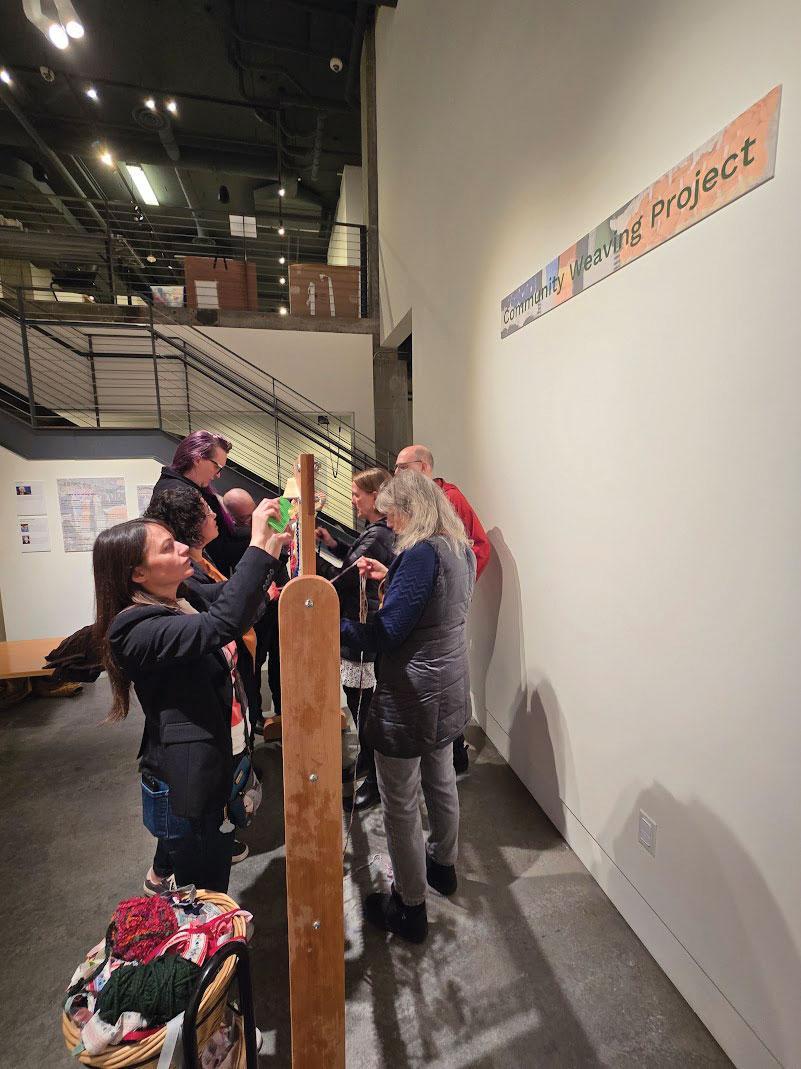
“unweaving.” Photo courtesy of Kathy Coffey Solberg
I cannot help but see the weaving of community in this issue of Welcome Magazine. When Solberg writes about the two-hour meeting that everyone attends and no one needs, I think of Thomas Amano at Seattle Paine Field International Airport (“Everything You Did Created That Moment,”), who built ownership of the terminal across every department. Staff turnover is negligible and people talk about teamwork, not silos of work.
Noticing needs a witness. When the reporter disappears, as this issue’s story about The Daily Herald (“125 Years of Showing Up“) puts it, the school board meets with no one taking notes and the county council votes with no one asking why. The paper is how a community sees itself whole — the shared understanding you have to reach before you can build anything on it.
You cannot unweave what you cannot see.
Solberg doesn’t pretend the work is easy. On a loom, tension is what makes cloth possible, and she writes that the same is true anywhere people are woven together: “Too loose, and the threads slip and tangle – nothing holds, commitments drift, accountability dissolves. Too tight and the threads snap…”
I told her it reminded me of the body. If we look for ease everywhere, we become slack and systems actually break down. We need the tension. We need the resistance. It makes you think harder, makes you work harder, makes you do better.
Sociologist Ray Oldenburg called the coffee shop and the barbershop third places — neither home nor work, but the spots where regulars know each other’s names — and Solberg says that is where the weft of community gets woven. Snohomish has one in a cigar shop (“Community Is Calling,”), where a bench outside the door does the work of a town square.
Solberg pushes one step past belonging. “Belonging says: ‘You’re here, you have a seat at the table.’ Mattering says: ‘Your presence changes what’s possible. Your contribution is valued, not just your compliance.’” A seat is where it starts. Mattering is when the room is different because you’re in it.
She ends nearly everything she writes with a question: “What does support look like?” The answer is different for everyone. The book’s own answer, the line she returns to on its last page, is this: “There is more of me when I am connected to you.”
A whole woven cloth. A community of weavers. A warp and a weft. And every thread matters. Φ