The Story Behind the Salmon Ceremony
BY MICHEAL RIOS
All photos by Micheal Rios

The late, great Bernie “Kai-Kai” Gobin is a cultural luminary for whom the Tulalip Hatchery is named. He was a devout fisherman, storyteller and warrior for his people. His name lives on via our hatchery, which, most amazingly, raises and releases 11.5 million juvenile salmon each year.
Yet, his true legacy endures via his story First Salmon Ceremony, which offers the foundation behind Tulalip’s now-annual Salmon Ceremony gathering and celebration. Kai-Kai’s ancestral wisdom can be found in the following 900-word traditional story:
sʔəsq̓ʷuʔ ʔə ti hikʷ siʔab yubəč
Long ago, the world was not like it is today. The stories show that animals could become people and people could become animals.
The stories also show that people and animals could talk to each other and understand each other. Long ago, then, when this is how things were, the salmon people and the ʔaciɬtalbixʷ had an agreement.
The salmon would come into the rivers each year and offer themselves as food for the people. The people would clean the rivers each year before the salmon arrived, and they would greet the salmon with a ceremony, and they would put the bones of all the salmon they had eaten back into the water. But as time went on, people became careless. There would be trash along the riverbanks and even in the water when the salmon came back. Fewer and fewer salmon were arriving. People were thinking: “If this goes on much longer, we are going to starve.”
One day, a young man was walking by the shore. He was asking himself, “Why is it that just a few salmon are coming anymore?” All of a sudden, the water rolled back, and up walked a person from beneath the sea.
“I have been sent to bring you back to the salmon village so you can get an answer to the question you have been asking,” he told the young man. “I will be your guide. There is another reason I was sent. Our leader is very ill. There is something he wants to say to you.”
The young man walked with the guide out to sea. The carpet of water rolled back over them until the young man looked up and could see fish swimming up above.
Then they arrived at the salmon village. His guide took him to the longhouse where the leader of the salmon lived. This man had been very sick since his return from the river by the young man’s village. “We have brought you here to see if you can understand the nature of our leader’s illness. Perhaps it is an illness from your world.”
The article continues below.

The young man was taken to a closed space at the back of the longhouse. An older man, very thin and wasted, was lying there with a fish hook stuck in the side of his head. The young man could see it clearly, but to the eyes of the salmon people it was invisible. “Young man, I hope you can help me,” said the leader of the salmon.
“I think I could help you,” said the young man. “But I am afraid that I would cause you a lot of pain.” The leader of the salmon asked for the help anyway. As soon as the young man had removed the fish hook, the salmon leader sat up, completely well again. “You have saved my life,” he said. “You have done a great thing for our people,” said the young man’s guide.
The young man stayed with the salmon people as an honored guest for some time. He heard about the agreement between his people and the salmon, how his people were to clean the rivers and welcome the salmon on their arrival. He had been unaware of these teachings.
When it became time for him to return to his people, the salmon began to teach him songs for a salmon ceremony, how to welcome the arriving King Salmon, how to sing a farewell as the bones were returned to the sea. The salmon leader spoke to him: “This is a message for you to take to your people. We will agree that as a tribe they will take care of the bones of just the first salmon. After that, each person will decide how they want to conduct themselves. Each year, we will send a scout to your village, and he will report back to us. If the river is clean and the ceremony is held and the bones of this scout salmon are taken good care of, we will come back each year.”
The young man was given many gifts and sent with honor back to his people. The young man instructed his people about the teachings that had been entrusted to him, and for a while everything went well. Then some people started to complain.
“It is too much trouble to gather up all these bones. Salmon have too many bones. Even if it is only once a year, it is too much trouble.”
The young man took the people down to the stream where the salmon were spawning. Some salmon were making their way completely out of the water, bruising themselves on the rocks, gasping for breath. Some with serious cuts in their bodies were resting in the pools before going on. Some had come to places where they had to jump ten times higher than any ʔaciɬtalbixʷ could jump, just to get to the next waterfall, where they would have to jump again. “Look how hard they are working to keep their side of the agreement,” the young man said.

And so, even to this day, each year the salmon scout arrives to see whether the ʔaciɬtalbixʷ will continue to live up to their side of the agreement. Each year, the scout reports back to his people about whether the ceremony was held, how his bones were taken care of and whether the salmon habitat was well maintained.
Each year, so far. That is the end.
We are now several generations removed from 1976’s revival of the first Salmon Ceremony spearheaded by Tulalip cultural pillars Harriette Shelton Dover, Bernie Gobin, Stan and Joann Jones, Molly Hatch and Mariah Moses. Their collective efforts to bring back the Salmon Ceremony to their people began by a simple gathering of the minds at Bernie’s house in 1970. The rest, as they say, is history.
In her autobiography, Tulalip From My Heart, Harriette recalls piecing together what she and her peers heard from their parents and grandparents of the annual, springtime tradition.
“When our people used to do the ceremony, it took hours and hours, and days and days. We felt we couldn’t do it that way; we had to sort of telescope it together,” she writes. “I wrote what I thought, and we made a good outline: the introduction or the first opening song, the blessing of the longhouse. Then we met again to beat the drums… we sang what we remembered.”
What they remembered were the teachings of their previous generation’s knowledge keepers. Five decades later, that same method of passing on teachings via the oral tradition from one generation to the next continues to be implemented. Such was evident at 2024’s wildly successful Salmon Ceremony.
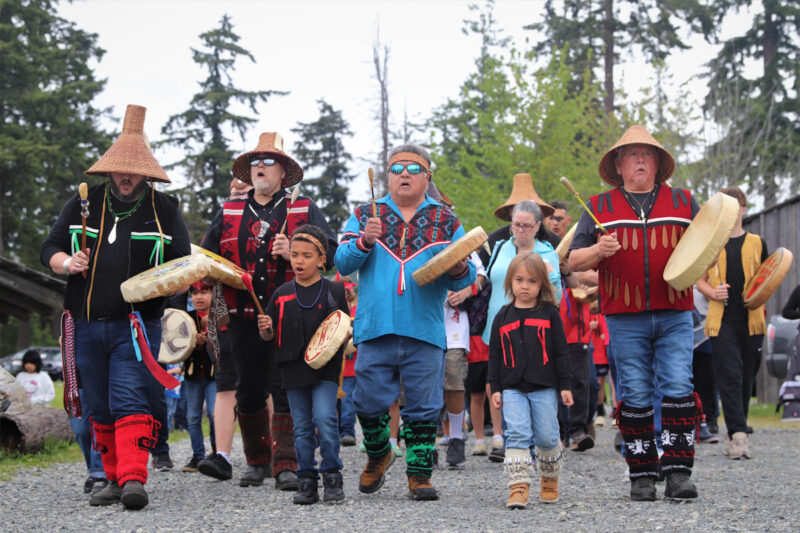
Shortly after sunrise, the dedicated Tulalips and their Coast Salish relatives convened above the shore of Tulalip Bay. They took in the lush Pacific Northwest landscape, reconnecting with friends and family before commencing with the recommitment of their shared responsibility.
“Salmon Ceremony is about giving respect to those that come from nature,” explains Glen Gobin, ceremony coordinator, recently re-elected to the Tulalip Tribes Board of Directors.
“But it also teaches about giving respect throughout life and honoring those gifts that we get, and respecting our way of life in a good way. Part of that is making sure how we sing the songs, how we conduct ourselves, it teaches how to carry yourself in life. All of the songs have meaning, everything is connected. The songs encourage the people to carry themselves in a good way.”
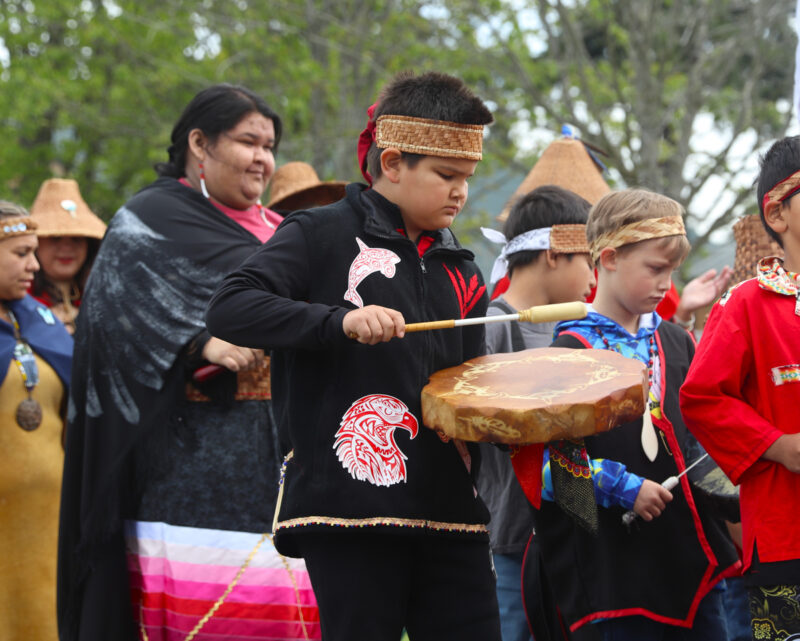
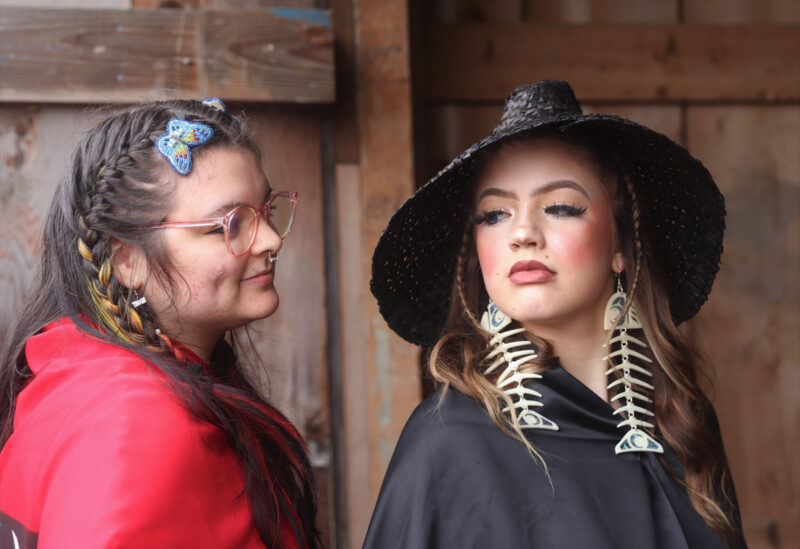
So many proud culture bearers wore their finest woven cedar hats and headbands atop their head, while donning shawls and vests adorned with abalone shells, miniature paddles and vibrant Native prints as they encircled the Longhouse fires in ceremony. The ancestors were made proud by the bellowing songs and rhythmic drum beats that radiated from the Longhouse and into the heart of Tulalip Bay.
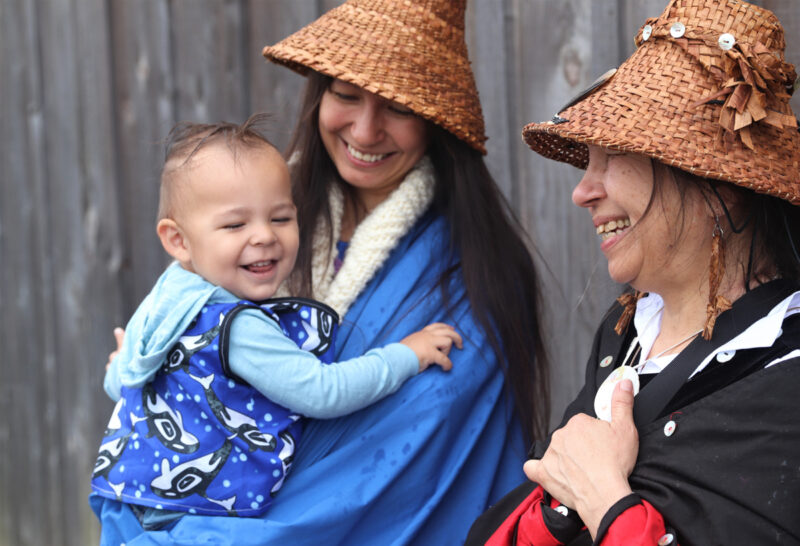
One could imagine Harriette and Kai-Kai beaming with the largest of grins, like that of the proudest great-grandparents ever, as they witnessed present-day Tulalips of all ages, newborn to grand elder, filling the Longhouse with Salish spirit at its finest.
Back in 1970, Harriette Shelton Dover and Bernie Gobin shared a dream to bring back a ceremony dedicated to the first salmon runs, fill the Longhouse floor and renew our people’s commitment as environmental stewards. In that respect, our Salmon Ceremony culture bearers are the literal manifestation of their ancestors’ wildest dreams.